Journal
4 min readThe Right Way to Code in 2026
A practical 2026 SaaS stack for speed: agentic editors, Next.js, React, TypeScript, Tailwind, shadcn/ui, Supabase, Vercel AI SDK, Clerk, PostHog, and Sentry, without rebuilding every layer from scratch.
- modern SaaS stack 2026
- Next.js SaaS
- Cursor vs Codex
- Vercel AI SDK

In 2026, the strongest product teams are not the ones rebuilding every layer from scratch. They ship with proven defaults, keep ownership of the code that differentiates them, and aim feedback loops at product-market fit, not boilerplate. That shift starts with how you write software: agent-assisted workflows, clear rules, and a stack that stays boring where it should be.
From typing every line to directing the work
Cursor’s documentation centers on agent mode, project rules, MCP integrations, skills, and CLI workflows. OpenAI’s Codex is positioned as an agentic partner that can read, edit, and run code in cloud and local environments. Both reflect the same direction: engineers spend less time on mechanical typing and more time on intent, architecture, and review. Pick the tool your team will actually adopt; the win is in constraints and habits, not the logo on the installer.
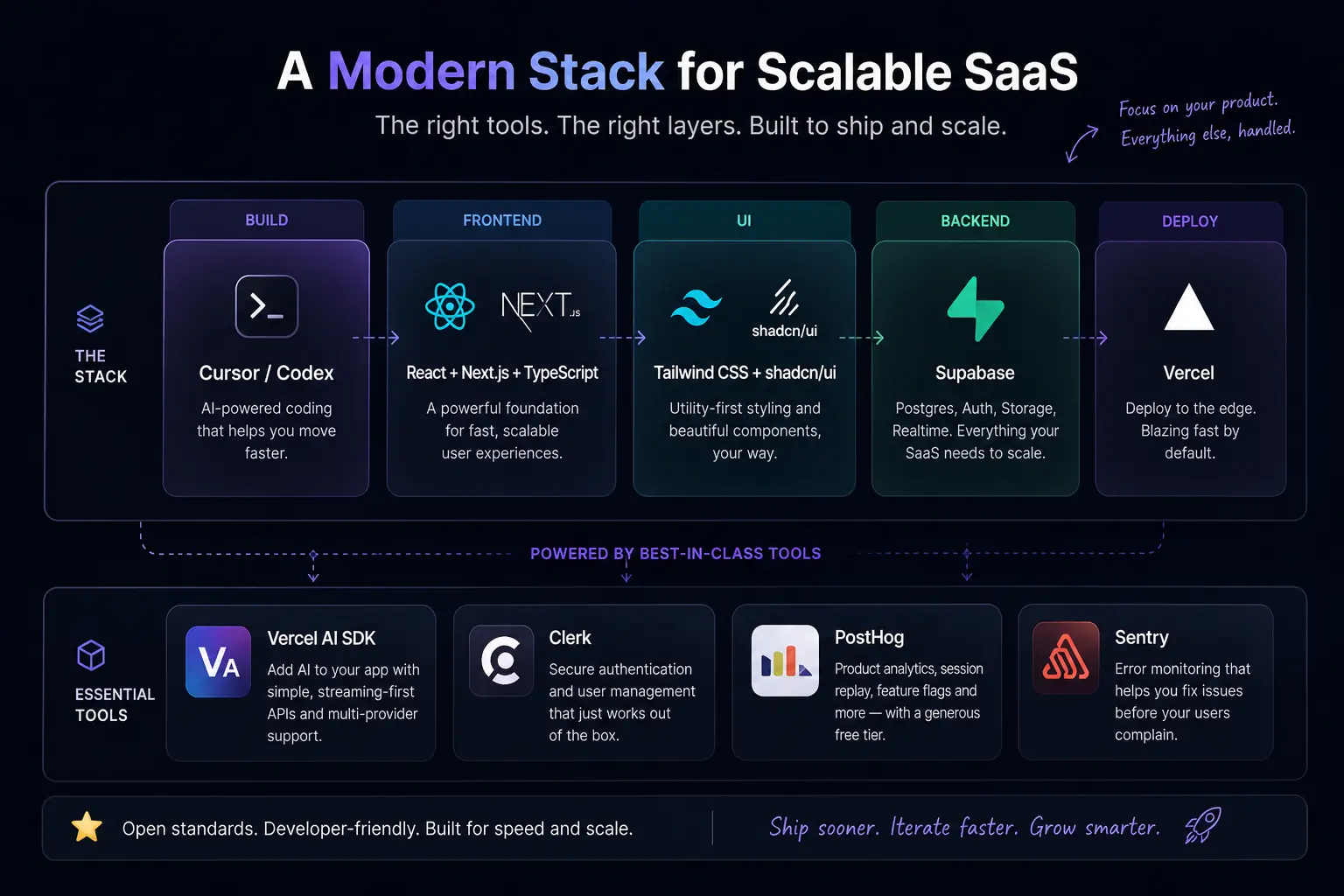
A SaaS-friendly core: Next.js, TypeScript, Tailwind, shadcn/ui, Supabase
For most SaaS products we ship or advise on, the application core stays intentionally simple:
- Next.js with the App Router and React Server Components where they earn their keep: clear routing, streaming, and deployment ergonomics on Vercel.
- TypeScript end-to-end so interfaces and refactors stay legible as the codebase grows.
- Tailwind CSS for fast, consistent UI without shipping a second styling runtime.
- shadcn/ui for accessible primitives that live in your repo: explicitly not a black-box dependency, but a pattern for building your own component layer on solid foundations (shadcn/ui docs).
- Supabase when you want Postgres, auth, storage, and realtime in one managed surface, useful when the product needs live updates, presence, or database-driven subscriptions without standing up bespoke infra for every feature (Supabase).
This combination reduces glue code without surrendering control: you still own structure, UX, and the parts of the stack that create defensibility.
AI in the product, not only in the editor
When the product itself needs models, streaming, or multi-provider routing, the Vercel AI SDK is a pragmatic TypeScript layer across React, Next.js, and Node, built around streaming, fallbacks, and provider flexibility (AI SDK). Pair it with clear evaluation and guardrails; the stack is only as trustworthy as how you measure it in production.
Identity, analytics, and reliability
- Clerk remains a strong default for auth and user management in React/Next.js products, with a generous free tier for early traction (Clerk).
- PostHog gives product analytics, session replay, and feature flags with a transparent free tier, useful when you want behavior data before you have a dedicated analytics hire (PostHog pricing).
- Sentry for errors, performance, and tracing across the full stack so regressions surface before they erode trust (Sentry).
How Hikari thinks about “the right way”
We bias toward defaults you can explain in a sentence, code you can hand off, and instrumentation from week one. If you are mapping a 2026 build and want a second opinion on stack, scope, or sequencing, start a conversation, or skim what we build. We are happy to pressure-test architecture before you commit quarters of calendar time.
Stack at a glance
| Layer | Suggested default |
|---|---|
| Editor / agents | Cursor or Codex (team norms + review matter more than the brand) |
| App shell | Next.js, React, TypeScript |
| UI | Tailwind CSS, shadcn/ui |
| Data & auth | Supabase (or equivalent managed Postgres + auth when it fits) |
| AI features | Vercel AI SDK |
| Identity | Clerk (when it fits your model) |
| Product analytics | PostHog |
| Errors / APM | Sentry |
The advantage in 2026 is not writing more code: it is making better choices sooner, then iterating from real usage. That is how you reach GTM without turning the repository into a pile of one-off experiments.
